
Have you ever been right in the middle of a granite job when the blade starts to slow down, or worse, it grabs and chips a tile you just spent time lining up perfectly? Or you’re out on a concrete pour and the rebar eats through another blade way too soon? I hear this from fabricators and contractors all the time—guys in shops from Texas to New York—and it’s one of those things that can throw a whole day off track.
I put this together to help you sort through the options and find the best diamond tipped saw blades that actually work well on granite, tile, and concrete. It’s based on what people are using on real jobs right now in 2026, so you get straightforward advice without the hype.
Types of Diamond Tipped Saw Blades: The Main Differences
The biggest difference between blades comes down to the tip style and how the diamond is bonded. A blade that’s great for tile can be terrible on concrete, and vice versa.
Here’s a simple breakdown of the types most shops and crews keep on hand:
| Diamond Tipped Saw Blade Type | Best For | Tip Style | Typical Life Expectancy | Wet or Dry Use |
|---|---|---|---|---|
| Continuous Rim | Tile, porcelain, marble | Smooth continuous rim | 8,000–14,000 sq ft | Wet preferred |
| Segmented | Concrete, brick, block | Segmented gaps | 5,000–11,000 sq ft | Wet/Dry |
| Turbo | Granite, quartz, engineered stone | Wavy turbo pattern | 6,500–13,000 sq ft | Wet/Dry |
| Turbo Segmented | Very hard granite | Turbo plus segments | 7,000–15,000 sq ft | Wet/Dry |
| Vacuum Brazed | Heavy rebar, metal-included concrete | Brazed diamond tips | Longest in tough conditions | Mostly dry |
Turbo blades have become the everyday choice for a lot of fabricators because they cut fast and leave a decent edge. Vacuum brazed ones are the go-to when you know rebar is going to be in the way.
Best Diamond Tipped Saw Blades for Granite Work
Granite can be unforgiving. Some slabs are so dense the blade just glazes over if the bond isn’t right.
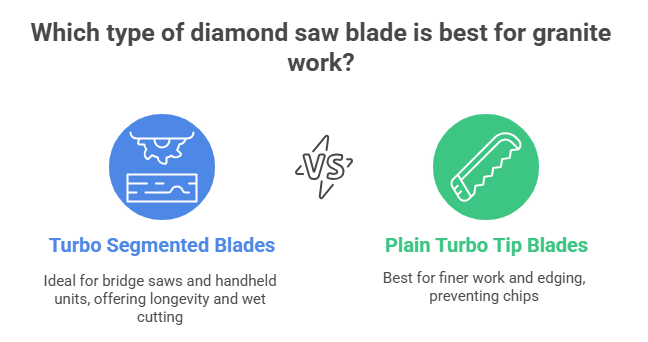
Most people I talk to lean toward turbo segmented blades for granite. They stay sharp longer on bridge saws and handheld units, and you can get a lot of square footage out of one blade when you run it wet. For finer work or edging, a plain turbo tip helps avoid small chips.
Cahard’s granite blades get good feedback from shops that run them hard. If granite is what you cut most, take a look at our granite saw blades and let us know your setup—we can point you in the right direction.
Top Diamond Tipped Saw Blades for Tile and Porcelain
Tile is all about clean edges. One little chip and the whole piece is scrap, especially on expensive porcelain jobs.
Continuous rim blades are still the standard for tile guys. Run them wet and you get that smooth, factory-like cut. Installers tell me they can go through dozens of large-format tiles without a single chip when the blade is right.
A thin turbo rim works well too if you need something a bit more versatile for handheld saws.
Best Diamond Tipped Saw Blades for Concrete Jobs
Concrete with rebar is rough on blades. Standard ones lose segments or just stop cutting the minute they hit steel.
Segmented blades with good undercut protection are what most crews use. A softer bond keeps new diamonds coming on abrasive mixes. Vacuum brazed blades take it up a notch when rebar is heavy—they don’t lose tips nearly as fast.
Here’s how bond hardness usually plays out on concrete:
| Bond Hardness | Best On | Why It Works | Trade-Off |
|---|---|---|---|
| Soft Bond | Abrasive, sandy concrete | Keeps sharpening itself | Wears faster on hard stuff |
| Medium Bond | General concrete, occasional rebar | Good all-around balance | Not the fastest or longest |
| Hard Bond | Dense, hard aggregate concrete | Maximum life | Slower on soft mixes |
Check our concrete saw blades when you’re stocking up for those kinds of jobs.
What to Think About When Picking Diamond Tipped Saw Blades
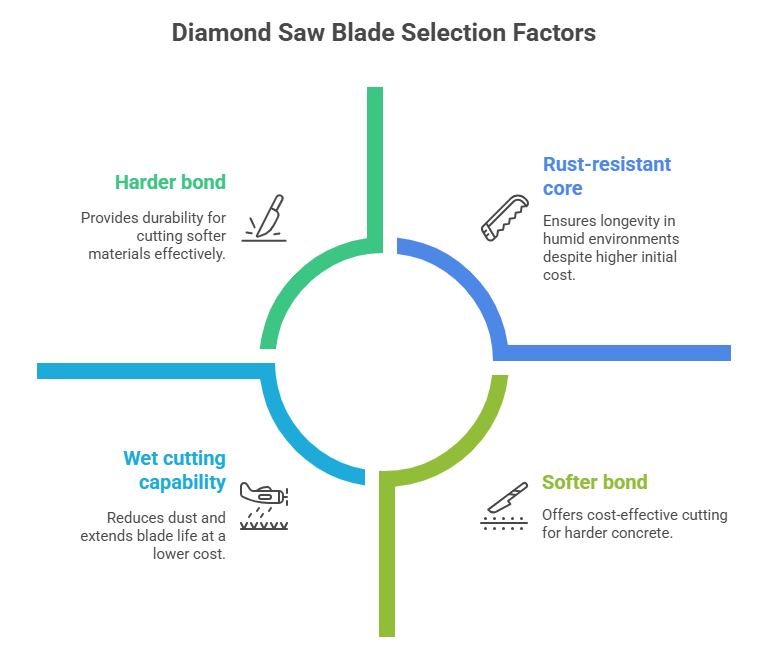
Start with what you cut most. Match the bond to the material—harder bond for softer stone, softer bond for harder concrete.
Your saw matters too—RPM, arbor size, wet or dry capability. Wet cutting makes blades last longer and keeps dust down, which is a big deal for OSHA rules.
Tip height is another factor—taller tips give more life, but they cost more up front. In humid areas, a good core that won’t rust is worth looking for.
Cahard blades use quality diamonds and solid construction without the big markup. Take a look at the full saw blade catalog when you need something new.
A Few Tips from the Shop Floor
Let the blade do the work—light pressure only. Keep water flowing steady if you’re wet cutting. Flip the material or switch sides on thick stuff to wear it evenly.
Safety is always first. Full gear, especially respirators on dry cuts. Wet cutting is the simplest way to stay within OSHA silica limits. Their site has all the details at the OSHA silica page.
The Natural Stone Institute has some solid blade safety info too—worth checking their safety resources.
FAQs
Why are diamond tipped saw blades better for granite than regular ones?
Diamonds stay sharp on hard stone much longer, giving you consistent speed and clean cuts without constant replacements.
Can one diamond tipped saw blade handle tile and concrete?
A turbo blade can do okay on lighter mixed jobs, but you’ll get better finishes and longer life using continuous rim for tile and segmented for concrete.
Do I need to wet cut with diamond tipped saw blades in the USA?
It’s not always required, but it’s the best way to extend blade life and meet OSHA dust rules on most sites.
When should I replace a diamond tipped saw blade?
When the tips are worn low or the cut slows down a lot—good technique can get you 6,000–15,000 sq ft out of a quality blade.
Where can I get good diamond tipped saw blades shipped fast in the USA?
Right here at cahardtools.com/saw-blade/—we keep the common ones in stock and can help you pick the right one. Contact Ms Alice at sales@cahard.com or +86 15902013674.
Need a blade that just works? Look through the site or drop sales@cahard.com a line—Ms Alice can help you find exactly what you need (+86 15902013674).